Inherited coins and provenance · Editorial field guide
How to Inventory an Inherited Coin Collection Without Removing Coins From Holders
Affiliate disclosure: Some marketplace links earn a commission if you buy. Listings are seller descriptions—not independent authentication or proof of value.
Quick answer. An inventory sheet should preserve the envelope as a unit before itemizing contents; a photograph of the handwriting can survive even if the paper becomes fragile. The practical goal here is container-first inventory template for heirs who do not know denominations, while keeping uncertain details visibly uncertain.
This guide is for someone handling coin and its original container—whether deciding what to buy, documenting a family find, or preparing a defensible sale description. The key is to investigate the exact example rather than relying on a broad category name.
What to establish first
The question: Container-first inventory template for heirs who do not know denominations. This is more specific than “Is it rare?” or “Is it worth anything?” because it can be answered from recorded evidence. An inventory sheet should preserve the envelope as a unit before itemizing contents; a photograph of the handwriting can survive even if the paper becomes fragile.
Before spending time on a valuation, establish which version or condition is actually involved. The practical risk is separating the coin from the envelope, cleaning it, or assuming an old pencil price is today’s offer. Neither age nor an attractive seller story resolves that uncertainty.
In-depth field guide
An inherited coin collection often arrives in a form that makes little sense to its new owner: coffee cans, blue folders, handwritten envelopes, plastic flips, certified holders, and envelopes marked with prices from decades ago. The first job is not to calculate an impressive total. It is to preserve enough context that a knowledgeable person can identify the coins accurately later.
Start with containers, not individual coins
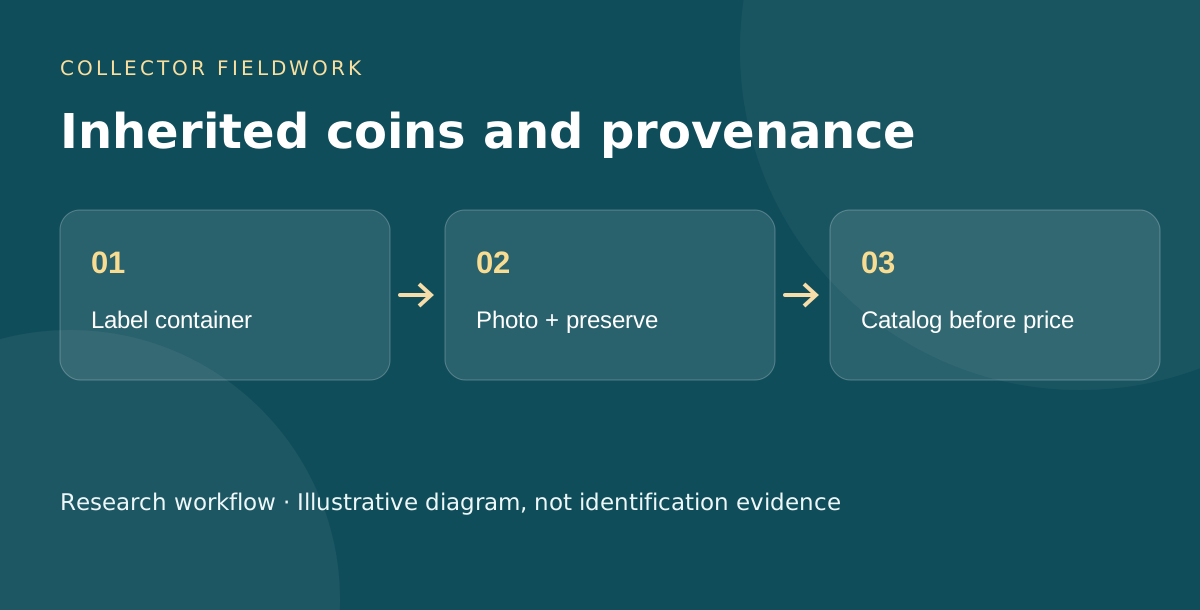
Give each box, album, jar, or envelope its own identifier: BOX-01, ALBUM-02, ENVELOPE-03. Photograph the container before moving anything. If a collector organized items together, that arrangement may indicate a series, a date range, or purchases made together. Take a picture of handwritten notes and keep them physically with their coins.
Create an inventory with these columns: container ID, item or group ID, denomination or description, date and mint mark if legible, count, packaging, visible concerns, photo filename, and follow-up priority. Leave unknown fields blank instead of guessing. A spreadsheet is useful, but a paper notebook is sufficient if entries are legible and photographed.
What should stay in its original holder?
A certified slab should not be opened casually. Record the grading service, certification number, description, and grade exactly as printed, then photograph both sides of the holder. Verification with the issuing service helps, but does not replace inspection of the actual item: certification numbers can be misused.
For cardboard holders, paper envelopes, and old collector flips, do not transfer coins merely to make the inventory look tidy. Older packaging can contain dates, dealer names, purchase notes, or other provenance clues. If storage material appears to be actively damaging a coin, seek guidance before changing it. An experienced numismatist can advise on safe conservation.
Sort by identification confidence
Use three groups: identified, partly identified, and needs specialist review. An identified piece has a readable denomination, year, and mint mark or an identifiable certified label. A partly identified piece might show only a design, a range of dates, or a worn mint mark. Specialist-review items include suspected gold coins, unusual errors, high-value certified pieces, unfamiliar ancients, and items with uncertain authenticity.
Do not turn the inventory into a price guide. Value depends on exact type, variety, authenticity, condition, and market conditions. A shiny coin is not necessarily uncirculated; an old coin is not necessarily scarce. For loose silver-colored pieces, do not infer silver content from appearance alone.
Photograph safely and consistently
Work over a clean, soft surface with one object at a time. Photograph the front and back of each high-priority coin or the whole labeled group when individual documentation is not yet practical. Use diffuse light to reveal detail without harsh glare. Include the container ID in the filename: BOX01-ITEM003-front.jpg. A photograph of a coin inside a holder is often better than removing it to eliminate reflections.
Keep raw images intact. Cropped copies can help later research, but retain originals to show lighting, scale, and context. Avoid rotating or digitally enhancing a photograph in a way that disguises scratches or changes visible surface characteristics.
A sample first-pass record
ENVELOPE-07 / ITEM-001 — “Silver Dollar” handwritten on envelope; one silver-colored coin; date partly visible; mint mark not yet read; inherited envelope retained; photos ENVELOPE07-001-front and -back; priority: research. This is a useful record even without a price, grade, or definitive identification.
For a certified piece, add the printed certification details and a note indicating whether you personally checked them. For an album, record the number of filled and empty spaces. Empty slots can reveal what the collector intended to assemble, but they are not evidence of what was once owned.
Preparing for an appraisal or sale
After the first pass, ask a specialist to review a shortlist instead of dropping every container on a dealer's counter. Prioritize possible gold, old silver dollars, key-date candidates, better certified coins, and unfamiliar material. Compare multiple offers or selling routes when material value warrants it. A dealer's bid, an auction estimate, a guide price, and an online asking price answer different questions.
Store the inventory separately from the collection and record who handled it, when it moved, and which offers were received. If the collection forms part of an estate, coordinate with the appropriate executor or legal representative before selling. Do not assume a personal tax or ownership rule applies in every jurisdiction.
The one rule that saves the most regret
Do not clean inherited coins. Brushing, dipping, or polishing may remove original surfaces and reduce collector value. PCGS specifically advises collectors against attempting to clean coins themselves. If you cannot identify something today, documentation and patience usually preserve more options than immediate intervention.
The finished inventory does not need to be perfect. It needs to make the next expert conversation safer, faster, and more informed.
Create an evidence ladder
Start with what is physically attached to the piece: the printed label, holder, wrapper or handwritten note. Next add original receipts, dated photographs, correspondence and auction records. After that come seller statements and unattributed stories. A convincing narrative is not the same as a demonstrated chain of custody; mark the distinction in the inventory instead of smoothing it over in a listing.
Preserve contradictory evidence. An envelope marked 1935 and a piece that seems later should trigger investigation, not a silent rewrite of either item.
The photographs or records that would settle it
Ask for container exactly as found, handwriting, holder front and reverse, surfaces under diffuse light. A photograph should be useful for diagnosis rather than just flattering. Save uncropped originals and label the views consistently so a specialist can request an additional angle without losing track of the object.
For How to Inventory an Inherited Coin Collection Without Removing Coins From Holders, a useful listing names the scope of what the seller actually checked: container-first inventory template for heirs who do not know denominations. An absent identification detail is different from ordinary cosmetic wear; it can change what object a buyer thinks they are purchasing. Save the seller’s answer beside your own observations.
A comparison worksheet for this exact question
| Question to resolve | Evidence to record | Decision if missing |
|---|---|---|
| Container or envelope id | Photograph, catalog reference, seller response or exact observation | Mark as not fully identified; defer valuation. |
| Denomination, year and mint mark as actually legible | Photograph, catalog reference, seller response or exact observation | Use original photo, label or third-party catalog; ask for a closeup. |
| Holder description and writing on accompanying paper | Photograph, catalog reference, seller response or exact observation | Price or sell conservatively; document the uncertainty. |
| Photos of both faces without removing anything | Photograph, catalog reference, seller response or exact observation | Seek specialist review if value materially depends on it. |
An illustrative decision—not a market valuation
Suppose two examples are advertised as the same kind of collectible. One provides container or envelope ID and denomination, year and mint mark as actually legible; the second uses only the broad category name and a single dramatic photo. The better-documented example is easier to research, return, insure and resell. That does not automatically mean it is worth more. It means fewer important facts are being left to imagination.
If you have more than one item, use the inventory CSV maker to preserve the evidence while each item is still in its original housing. The tool runs locally in your browser without uploading an inventory.
The non-obvious part
An old envelope can be part of the evidence. The U.S. Mint recommends retaining certificates and accompanying documentation. A family label can record a transaction or earlier identification, even if the identification turns out to be wrong. Never separate paperwork before photographing it. Primary source.
Mistakes to avoid and a safe stopping point
The main trap in this category is separating the coin from the envelope, cleaning it, or assuming an old pencil price is today’s offer. Before a purchase or alteration, confirm: (1) the identity, (2) physical condition, (3) documentation, and (4) the financial or legal consequence of being wrong. If any one of those is material but cannot be checked, ask for evidence or decline the transaction.
Editorial accuracy boundary: Record every label and keep provenance attached. This is a verification requirement, not an assertion that the item under discussion has passed inspection. No unseen object is authenticated, appraised or certified by this guide.
Seller question you can copy into a message
I am researching how to inventory an inherited coin collection without removing coins from holders. Could you show container or envelope ID and explain container-first inventory template for heirs who do not know denominations? Please distinguish what you checked personally from what came from a previous owner or grading label. I would also appreciate your return terms if the identification is incorrect.
The answer should create something you can verify, not merely a reassuring adjective. If a seller gives a precise limitation (for example, “I have not tested coin and its original container”), record that limitation exactly. It may be honest and useful without proving the condition you need.
Practical questions readers ask
What matters most for inventory an inherited coin collection without removing coins from holders?
The first test is container or envelope ID, followed by denomination, year and mint mark as actually legible. Those details let you narrow the object down before anyone starts guessing a premium.
What if the listing has too few pictures?
Request an uncropped view that resolves the missing identifying mark or condition question. You can save the listing for later, but do not use its price as a comparable until you know the versions actually match.
Should I repair, clean, open or alter it before asking an expert?
Usually document first. An alteration can remove provenance or condition evidence; fragile items and high-value pieces merit qualified advice. The right treatment depends on material and condition rather than an all-purpose cleaning hack.
Marketplace research after identification
Disclosure: We may earn a commission if you purchase through this eBay link. This does not affect the identification steps or any conclusion above.
Browse relevant eBay listings to inspect — search for “coin storage archival flips.” This is a live search, not a verified offer or completed-sale price. Check the actual listing, seller, legality where relevant, and return terms. For valuations, separately review genuinely comparable sold transactions.
References, research limits and related reading
- US Mint collecting and care guidance — official or specialist guidance, not a certificate for the item in this article.
Companion guides in this package (publish these routes together):
- How to Photograph an Inherited Coin Collection for an Appraiser
- Inherited Coin Jars: A Safe First Sorting System
- How to Compare Two Offers for the Same Estate Coin Collection
Collection and buyer education, not individualized appraisal, authentication, legal or investment advice. We have not physically inspected the collectibles described. Affiliate transactions should be independently verified before publication.